Here’s what’s left…dead/living and human/divine in “Engel” (I think I have covered enough already in “Heirate mich”), self/family in “Spieluhr,” and disconnect-as-affirmation as seen in “Bestrafe mich,” “Bück Dich,” and “Feuerrader.”
As is the case in other songs, “Spieluhr” works with inversions, beginning with the first line, where the child only pretends to die and fools those around him, through the return to life at the end—a return that is not a resurrection. To me, the really interesting aspects of “Spieluhr”are the nuances that point to the myth of Orpheus, a figure who went into Hades to bring forth his beloved with the power of his music. Orpheus’s journey was for naught because he turned to see Eurydice before she came fully into the sunlight. Similarly, one could argue that the child in “Spieluhr” is not permitted to exist authentically and play his music box, but instead is forced back into a world not of his making. If to play music is to create a world, then the child is denied the power of creation, which is the ultimate act of power that we the living have. Life for the child becomes death. The rescuers—we may assume that it’s the child’s family, but there is no evidence in the song that points to it—have brought the child from the life it preferred into the death it was trying to escape.
"Engel" also plays with inversions. The angelic figures in this song are nothing like the saccharine caricatures commonly found in American culture, nor are they like the more delicately nuanced representations seen in some European art. They are a far cry from Paradise Lost as well, where angels are immensely powerful, made from matter that is neither human nor properly divine but yet is overwhelmingly and innately good. The angels in “Engel” exist without a god; the voice of the angel says, “wir haben Angst und sind allein.” Of what use is an angel without a divine force to guide it? Being an angel would bring one into direct apprehension not of the divine, but of the ultimate meaninglessness of existence. No wonder the narrator of the song insists, “Gott weiß ich will kein Engel sein.”
I am going to save the last three songs in this topic for a separate post. See, not everything I write is as long as the average 19th-century Russian novel. Some of it's longer.
Tuesday, May 23, 2006


impossibility of authentic connection, part 2
I hadn’t worked this hard on something literary since I was hammering away at my doctorate…I hope you guys find it interesting, and I look forward to reading your comments. Not that I have any illusions that my groupies will find this page.
--
Let’s see, what’s left from my brief list…the impossibility of authentic connection between artist/audience in “Links 234” (I am omitting “Ich will” because I know I’m overly influenced by the video), self/self in “Zwitter.” self/other in “Eifersucht,” dead/living and human/divine in “Engel” and “Heirate mich,” and self/family in “Spieluhr.” (I had previously listed “Tier” and “Spiel mit mir,” but I don’t think I have much that’s new to contribute. I wrote a lot about them, then cut it.) I will add to this list the perpetual disconnect between sexual partners, specifically the imposed disconnection as seen in “Bestrafe mich,” “Bück Dich,” and “Feuerrader,” and how these relationships attempt to affirm themselves.
Aside from being a response to critics, “Links 234” asks some interesting questions about metaphors concerning hearts. It’s as if the narrator is pointing out that these metaphors, as listed in the lyrics, are poor substitutes for direct description, yet at the same time the narrator employs a metaphor to describe his own political position:
Sie wollen mein Herz am rechten Fleck
doch seh ich dann nach unten weg
da schlägt es links
To question an artist’s position based on inferences drawn from the cover of a CD is, of course, ridiculous (and this song came out well before the Linkspartei was created earlier this year). Metaphors are matters of convenience, yet the narrator uses a metaphor to reject metaphors. This ambiguity creates a fascinating intersection between the poet and the political activist. If we can use metaphors to describe states of being, then the poet is the ultimate political activist, because poetry, at least what one might think of as conventional poetry (not considering avant-garde poetry here), excels at metaphor. If political skill means choosing the right metaphor at the right time, then poets are political savants.
“Zwitter” is interesting because in its description of the utterly self-absorbed person, it describes the figure that is increasingly becoming Everyman, at least in America. (Reading the second stanza is like reading a chapter from a self-help book.) The problem with self-absorption is the lack of reference and the tightening spiral of consciousness, a lesson probably presented best in Milton’s Paradise Lost. Without external reference, just as with the characters in “Tier” who have little externality, the narrator of “Zwitter” will never be able to experience any of the real depth of character that comes from connecting with others. He will be all surface, no depth—and that includes his understanding of himself. Thus, self-alienation is his only reward for his self-love.
Sometimes self-love begets jealousy of others, and sometimes jealousy is a reaction to other circumstances. “Eifersucht,” as a portrait of the jealousy of others, relies on an interesting poetic convention, that of the blazon. The blazon was a cataloguing of a woman’s body in order to fully explicate her beauty. In “Eifersucht,” however, the fine qualities of the narrator are catalogued, and in the process, so is the mixed jealousy and envy of the onlooker:
Bin ich schöner
zerschneid mir das Gesicht
bin ich stärker
brich feige mein Genick
bin ich klüger
töte mich und iss mein Hirn
Hab ich dein Weib
töte mich und iss mich ganz auf
dann iss mich ganz auf
“Eifersucht” could be applied far beyond simple love relationships, of course; rival bands, other performers, critics, the boyfriends of female fans, all such persons and others could feel passionate and violent desires. One could also argue that because this is a message from one man to another, the violence is expected and perhaps even unremarkable. The key phrase occurs in the second stanza—“doch leck den Teller ab,” i.e., do the job completely, because otherwise, you’re still a dumb, ugly coward. The narrator is better in every way than the onlooker, both of them know it, and worse, the woman in question knows it. The narrator taunts the onlooker not with his own superiority, but with the onlooker’s poor showing. To destroy the narrator, even down to his soul, will not make the onlooker superior. The narrator is a work of art, and compared to him, the onlooker is miserable, incapable of taking Rilke’s advice in “Archaic Bust of Apollo”: Du mußt dein Leben ändern, “You must change your life.” The threat of violence is the onlooker’s only response to art, a threat that makes him nothing more than a beast.
Rammstein: impossibility of authentic connection, part 1
This was the first theme I dealt with. For me, it is the übertheme (would Germans permit that linguistic crossfertilization?). I’m relying on the lyrics rather than the videos, interviews, etc.
--
The impossibility of authentic connection with another appears with regard to just about every relationship: creator/creature in “Mutter,” country/country in “Amerika,” lover/beloved in “Heirate mich” and “Stein um Stein,” artist/audience in “Links 234,” self/self in “Zwitter,” self/other in “Eifersucht,” among family members in “Tier” and “Spiel mit mir,” dead/living (and perhaps even human/divine) in “Engel” and “Heirate mich”…I am stopping at this point because there’s plenty to talk about with these few songs.
The balancing act that’s required to convey these ideas is tricky. The narrator of a given song generally has a fair level of self-knowledge, yet at the same time possess a certain blindness about his condition. Sometimes that blindness is self-imposed, sometimes it comes from without. For instance, the creature in “Mutter” has no way of finding authentic connections with relatives because he has none, yet he is nevertheless a human being. (NB: By “creature” I mean “one who is created,” not “a horror to be avoided.”) He lacks the most fundamental assumption of existence. How, then, does one in such a position define oneself? Does this represent the ultimate state of freedom? If so, how do we respond to the creature’s reaction to that freedom?
As with most Rammstein songs, “Mutter” is internalized, i.e., it comes from the center (but perhaps not the core) of the narrator’s consciousness. However, “Amerika” is on the macroconscious scale. (I’m not sure that’s a word, but I like it and it’s coming with me.) The stanza that switches to first person is telling:
This is not a love song
This is not a love song
I don't sing my mother tongue
No, this is not a love song
When every country has been homogenized into the cultural puree that is America, there is no motherland, no mother tongue. English becomes the mother tongue that smothers, just as American culture is the culture that assimilates. Without a sense of political individuality, when political identity has been imposed from without, authentic self-awareness becomes impossible. The “I” in this stanza appears long enough to say what it is not saying (an interesting notion), then melts back into the “we.”
Even normal, garden-variety relationships become impossible. In “Stein um Stein,” the lover’s desire to possess the beloved drives him to wall her in. Note that she makes no attempt to resist; this is the ultimate conclusion to the romantic-relationship-cum-rape-fantasy that American culture insists is the norm. The lyrical richness comes from its blend of fairy-tale imagery and modern bodice-ripper sensibilities, along with a healthy dose of Poe’s “The Cask of Amontillado.” There is similar richness, albeit from different sources, in “Heirate mich.”
“Heirate mich” holds a special place for me for a couple of reasons: One, because the mind of the narrator is so fully present in the lyrics, and two, because of the etymology of the title. The latter is of interest here. Those of you who have had a little Greek or who have studied linguistics will see similarities between hieros ‘sacred’ and heiraten ‘to marry,’ i.e., to consecrate through marriage (though the path from Athens to Berlin seems to pass through the Gothic term heiwa ‘household’). The narrator of “Heirate mich” has driven himself mad hanging around the grave of his fiancée, who, if I’m interpreting things correctly, died on their wedding day. She is buried in sacred ground (“dort bei den Glocken”), she wears the vestments of her sacred role as bride (“im schönsten Kleid”), yet none of this is enough to save the lover. He becomes more profane the longer he is around the sacred, until he blends the two by having sex with his beloved. There can be nothing sacred, and at the same time nothing profane, so long as there is such alienation.
By the way, the song playing while I wrote that last bit was “Happy Together” by Lovin’ Spoonful.
Rammstein: introduction
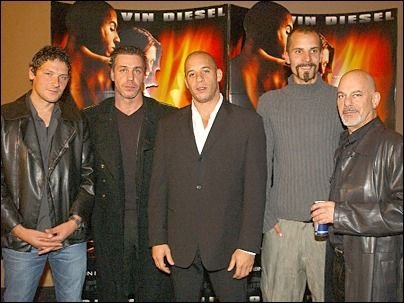
My Rammstein essays were originally part of a series posted on both Herzeleid.com and the official Rammstein fan area. It kills me to see them expire, so I caved in and got a Blogger site.
This image is of three of the band members (Doom, Till and Olli) with Vin Diesel and another man (the one on the far right..I'm sure he's terribly important, and terribly offended). The other band members are Paul, Flake and Richard. Give the names a German pronunciation, if you don't mind. They're hanging out with Vin Diesel because they performed in his film xXx.
The music is great, but the lyrics are what have kept me interested. I used to be a Tool fan. Once I discovered the depth of Rammstein's lyrics, I changed codes.
themes
I am more interested in ideas than people or events.
Anything can be anything, but without an idea spurring it on, it's worthless.
Unexamined ideas are worse than unexamined lives. An unexamined life may yield good and just actions; an unexamined idea is at best repetition, at worst malicious ignorance.
Welcome to the world of my ideas. I claim only what originality my tone and style can lend them.
Anything can be anything, but without an idea spurring it on, it's worthless.
Unexamined ideas are worse than unexamined lives. An unexamined life may yield good and just actions; an unexamined idea is at best repetition, at worst malicious ignorance.
Welcome to the world of my ideas. I claim only what originality my tone and style can lend them.
Subscribe to:
Posts (Atom)